
5 Reasons Pain Shifts During Treatment (And Why It Doesn’t Always Mean You’re Getting Worse)
Understanding how your body’s connected muscles, joints, and movement patterns influence discomfort during recovery.
Pain shifts during treatment for several possible reasons, and it can be confusing when one area finally feels better just as another starts to hurt.
Imagine this.
You’ve been dealing with tight, painful hips for months. Walking has become uncomfortable, your lower back constantly feels strained, and sometimes that familiar sciatic pain travels down your leg.
You finally decide to do something about it.
After treatment, your hips begin feeling better. You’re moving more comfortably, standing straighter, and perhaps even sleeping better.
Then something unexpected happens.
Your sciatica starts acting up again.
Or perhaps your lower back feels wonderful, but now your shoulders are bothering you. Maybe there’s tension between your shoulder blades that you hadn’t noticed before.
And naturally, you start wondering:
“Why does it feel like every time we fix one thing, something else starts hurting?”
It’s an understandable question.
When we’re dealing with ongoing pain, we tend to think of improvement as a straight line. We expect treatment to reduce discomfort until eventually everything feels normal again.
But our bodies don’t always work that way.
Sometimes, as one area becomes less restricted and movement improves, discomfort elsewhere becomes more noticeable.
This doesn’t necessarily mean treatment isn’t working. It may mean other muscular restrictions, compensating movement patterns, or existing problems still need attention.
Of course, new pain isn’t automatically a positive sign either. That’s why understanding what has changed is so important.
At Acupuncture & Homeopathy Clinic, we believe in looking beyond the immediate location of discomfort to understand how the body works together.
Let’s explore five reasons pain can appear to shift during treatment and why those changes deserve attention rather than frustration.

1. Your Body Has Been Compensating for the Original Problem
One of the most remarkable things about the human body is its ability to adapt.
When something isn’t working properly, another part of your body often takes on extra responsibility.
Think about how you walk when you have a sore ankle.
Without consciously deciding to do so, you shift your weight toward the opposite leg. Perhaps your hip begins moving differently, or your lower back takes on additional strain.
You can still get around, but you’re no longer moving the way you normally would.
Now imagine doing that for weeks, months, or even years.
Your muscles become accustomed to these altered patterns. Some may remain tense or overworked, while others aren’t being used as effectively as they could be.
When treatment begins improving the original restriction, your movement patterns may begin changing again.
That adjustment can place different demands on muscles and joints that have been compensating for a long time.
You may notice soreness or tension in areas that didn’t previously bother you.
Does this mean you’re getting worse?
Not necessarily.
It may mean that one restriction has improved while other contributing factors remain.
This is why I emphasize that the body cannot be treated as a collection of unrelated parts.
What happens in one region can influence how another region functions.
Understanding those relationships helps us make better decisions about what to address next.
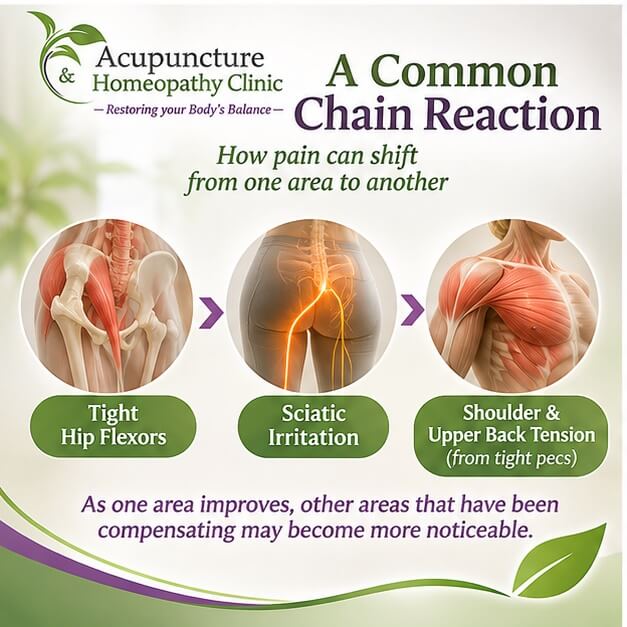
2. Tight Hip Flexors Can Contribute to a Chain of Discomfort
Let’s look at an example that illustrates how connected the body really is.
The hip flexors are a group of muscles located primarily around the front of your hips.
They include the iliopsoas, made up of the psoas major and iliacus muscles, along with other muscles that assist with hip movement.
These muscles help lift your legs, support movement, and contribute to control of the pelvis and lower body.
When hip flexors become restricted, they can affect how comfortably your hips move.
For example, someone who spends much of the day sitting may develop reduced hip mobility. During walking, their body may compensate for limited hip extension by changing the way their pelvis or lower back moves.
Over time, these movement patterns may contribute to muscular tension and discomfort.

Here’s where things get interesting.
Imagine a patient who arrives with tight hip flexors, lower back discomfort, and intermittent sciatic symptoms.
We begin working on the muscular restrictions around the hip using Neuromuscular Therapy.
As the tension decreases, the patient begins noticing improvements.
Their hips move more comfortably. Their stride improves. Standing and walking may feel easier.
But then they return and tell me:
“My hips feel so much better, but now my sciatica is bothering me again.”
It’s tempting to think that the pain has simply moved.
However, there may be several explanations.
The original sciatic problem may not have fully resolved. Increased walking or activity may be aggravating an already sensitive nerve. Or other restrictions in the lower back, pelvis, and surrounding muscles may still be contributing to their symptoms.
Importantly, sciatica involves irritation or compression affecting nerve pathways, and it isn’t necessarily caused by tight hip flexors.
Improving the hip muscles can help reduce a contributing movement restriction without automatically resolving a separate nerve problem.
This doesn’t erase the progress made in the hips. It tells us that we need to reassess the larger picture.
Rather than assuming the treatment has failed, we evaluate what’s improving, what’s changed, and what may still require attention.
This is precisely why reassessment is such an important part of effective care.
3. As One Pain Improves, You May Notice Another Problem That Was Already There
Have you ever had a terrible headache and barely noticed that your shoulders were tight?
Then, once the headache disappeared, suddenly the tension in your neck and shoulders seemed impossible to ignore?
This illustrates another reason pain may seem to shift.
Our attention naturally gravitates toward whatever is bothering us most.
When a particular area is especially painful, other sources of discomfort can fade into the background.
They haven’t necessarily disappeared. They’re simply less noticeable.
Now imagine someone who has been dealing with significant lower back or hip pain.
For weeks, their attention has been focused almost entirely on getting through the day without aggravating those symptoms.
As treatment begins reducing that discomfort, the patient finally notices tightness in the chest, stiffness in the shoulders, or aching between the shoulder blades.
It may feel like a brand-new problem.
But sometimes it was there all along.
Let’s consider tight pectoral muscles.
The pectoral muscles, located across the front of the chest, play an important role in shoulder movement.
When these muscles are restricted, they can contribute to altered shoulder positioning and limit certain movements.
For some people, this may be associated with tension through the shoulders, upper back, and neck.
Someone who spends long hours working at a computer, looking down at a phone, or maintaining a forward-leaning posture may develop several overlapping restrictions.
The original hip or lower back pain might have been their biggest concern.
Once that improves, the upper-body discomfort becomes more apparent.
It doesn’t necessarily mean the hip problem caused the shoulder problem, or that one somehow traveled into the other.
Instead, there may have been several issues occurring simultaneously.
As the most noticeable pain improves, we sometimes become more aware of the other restrictions that still need attention.
This is another reason we prefer looking at the entire body rather than focusing exclusively on the most painful spot.
4. Feeling Better Often Means Moving More, and Your Body Must Adjust
Here’s a situation many patients can relate to.
You’ve been dealing with pain for months.
You’ve stopped taking long walks. You’ve avoided certain exercises. Maybe you’ve been careful about bending, lifting, or even getting out of bed.
Then treatment begins helping.
Suddenly, you’re feeling better!
So what do you do?
You start doing all the things you’ve been missing.
You walk farther. You spend more time gardening. You tackle household projects. Maybe you even return to the gym.
And the next morning?
Something hurts.
It’s frustrating, especially when you thought you were finally past the problem.
But there is an important distinction between reducing pain and rebuilding the body’s ability to tolerate activity.
When discomfort improves, it doesn’t necessarily mean that every muscle has regained its previous strength, endurance, flexibility, or coordination.
You may be moving more freely, but your body could still be adapting to demands it hasn’t experienced for some time.
For example, someone with restricted hip movement may begin taking longer, more comfortable strides after treatment.
That’s encouraging.
However, if they suddenly double their usual walking distance, they may aggravate existing lower back symptoms or develop muscular soreness in areas that haven’t been working as hard.
The solution isn’t necessarily to stop moving.
Instead, we want to understand what triggered the discomfort and whether activity needs to increase more gradually.
Progress often involves finding the balance between improved movement and allowing the body time to build tolerance.
This is why communication between treatments is essential.
I want to know what activities you’ve resumed, what feels easier, and what causes discomfort.
Those details help us distinguish meaningful improvements from symptoms that require a different approach.
5. The Original Pain May Have Been Only One Part of a Larger Problem
This is perhaps the most important reason of all.
Sometimes the area that hurts isn’t the only area contributing to the problem.
Consider someone with persistent lower back discomfort.
The issue may involve restricted hip movement, tension in surrounding muscles, altered walking patterns, reduced muscular endurance, or irritation affecting nerves.
Several factors may exist at the same time.
If we focus only on the lower back because that’s where the pain is strongest, we may overlook other restrictions affecting how the person moves.
This is where our approach to Neuromuscular Therapy becomes especially valuable.
Neuromuscular Therapy focuses on addressing muscular tension and restrictions that may contribute to discomfort and altered movement.
Using the Meilus Therbo Robot, we work on specific muscular areas, with the aim of relieving tension and helping improve movement.
An important part of our approach is examining opposing and compensating muscle groups.
For example, tight muscles around the front of the hips may coexist with restricted or overworked muscles elsewhere around the pelvis.
Addressing one area can improve movement, but other muscular patterns may still require attention.
We also incorporate acupuncture when appropriate.
From the traditional Chinese medicine perspective, acupuncture is used to stimulate the body and support the flow of Qi through its channels.
We incorporate it as one part of an individualized approach to pain management and overall well-being.
These treatments have different methods and purposes, and we select them based on what we find during assessment.
The goal isn’t to repeatedly treat whichever area happens to hurt that day.
The goal is to understand the factors contributing to discomfort and determine which ones we can appropriately address.
This doesn’t mean every pain has a single hidden muscular cause. Some symptoms involve joint conditions, nerve compression, inflammation, or other medical problems that need separate evaluation.
Understanding those distinctions is part of providing responsible care.
Why Changing Pain Doesn’t Automatically Mean You’re Going Backward
After reading these five reasons, you may recognize something you’ve experienced yourself.
Perhaps your hip mobility improved, but your lower back still occasionally bothers you.
Maybe your sciatica has become less frequent, but you notice discomfort after a particularly active day.
Or your shoulders are finally relaxing, but you’ve become more aware of tightness between your shoulder blades.
It’s easy to judge progress by asking one simple question:
“Do I still have pain?”
But that question doesn’t always tell us enough.
What if your pain occurs less frequently?
What if you can walk for thirty minutes instead of ten?
What if getting out of your car no longer requires careful maneuvering?
What if you can reach overhead more comfortably, turn your head more easily, or sleep through the night without constantly changing positions?
Those are meaningful changes.
They help us understand whether function is improving, even when some symptoms remain.
However, I also want to emphasize something important.
A new pain isn’t proof that your body is healing, and worsening symptoms shouldn’t be dismissed as a normal adjustment.
A meaningful assessment must consider both improvement and any new concerns.
The goal isn’t to explain away discomfort. It’s to understand what’s happening.

Assess. Treat. Reassess.
This philosophy is at the center of how we approach care at Acupuncture & Homeopathy Clinic.
Assess: We begin by understanding your symptoms, movement restrictions, muscular tension, and the activities that aggravate or relieve your discomfort.
Treat: We select appropriate therapies, which may include Neuromuscular Therapy, acupuncture, cupping, or a combination based on your individual needs.
Reassess: We evaluate how your body responds. Has your range of motion improved? Are everyday activities easier? Has the original discomfort changed? Have new symptoms appeared that need further investigation?
Each reassessment gives us more information.
Sometimes the treatment plan continues as expected.
Sometimes we shift our attention toward another muscular restriction.
And sometimes a change in symptoms tells us that a medical evaluation or different approach is needed.
That’s not failure.
That’s thoughtful, responsive care.
The body is constantly adapting to movement, activity, and the demands of everyday life.
Our responsibility is to pay attention to those changes rather than assume that every patient will follow the same predictable path.
The Bigger Picture: Progress Isn’t Always a Straight Line
One of the things I love most about working with patients is seeing improvements that they sometimes don’t recognize in themselves.
A person may arrive disappointed because their shoulder is sore, completely overlooking the fact that they’re now walking comfortably after months of hip pain.
Another may focus on an occasional sciatic flare-up without realizing how much more freely they’re moving throughout the day.
Those improvements matter.
But so do the symptoms that remain.
Our goal isn’t to convince someone that every new discomfort is a good thing.
It’s to help them understand that recovery can involve several overlapping issues, and that meaningful progress is often measured through improved function as well as pain relief.
Sometimes one restriction improves while another becomes more noticeable.
Sometimes greater activity reveals a problem that still needs attention.
And sometimes the body simply needs a different approach.
What matters is recognizing the difference.
Because successful care isn’t about pretending that pain doesn’t exist. It’s about understanding why it’s happening, measuring what is improving, and responding appropriately when things change.
Final Thoughts: Listen to Your Body, But Look at the Whole Picture
If you’ve ever felt frustrated because one area of pain improved only for another area to begin bothering you, you’re certainly not alone.
The body is an interconnected system, and the way we move, compensate, and adapt can influence symptoms throughout different regions.
Tight hip flexors may contribute to restricted movement and lower back strain.
Sciatic symptoms may persist even after hip mobility improves because nerve irritation has its own causes.
Restricted pectoral muscles may contribute to shoulder and upper back tension that becomes more noticeable once another painful area settles down.
None of these patterns automatically means treatment has failed, and none should be assumed to be proof of healing without assessment.
That’s why we keep coming back to three simple words:
Assess. Treat. Reassess.
By looking beyond the immediate location of pain, monitoring changes in movement, and adapting treatment as needed, we can work toward better function, improved comfort, and a more complete understanding of what your body needs.
Remember, progress isn’t always about where you hurt today.
Sometimes it’s about what you’re finally able to do that you couldn’t do yesterday.
And sometimes it’s about recognizing what still needs attention so you can continue moving forward.
Restoring your body’s balance is a process, and understanding that process is an important part of the journey.
Acupuncture & Homeopathy Clinic
Restoring your Body’s Balance
7241 Bryan Dairy Road, Largo, FL 33777
727-420-7600
ANHClinic.com
https://acupuncturehomeopathy.com/contact/
If you’ve been experiencing recurring muscle tension, changing discomfort, or restricted movement, contact our clinic to schedule a consultation. We can discuss your symptoms, evaluate your movement, and determine whether our services may be appropriate for your needs.