
Understanding the Small Signals Your Body Sends Before Pain Becomes Chronic
By Dr. Petra Tibshraeny
When people visit my clinic for the first time, one of the most common things I hear is, “I wish I had come in sooner.” Sometimes they have lived with a stiff neck for six months. Sometimes a shoulder has bothered them for years. Often, the discomfort was not constant at first, so they assumed it would eventually disappear. They didn’t listen to the early warnings.
I understand why people wait. Life gets busy, and a symptom that appears only after gardening, driving, or sitting at a computer may not feel urgent. Yet recurring tightness, reduced movement, disturbed sleep, headaches, or discomfort that comes and goes can be early warning signs that the body needs attention.
After more than twenty-five years in practice, I have learned that the body usually communicates before a problem begins controlling daily life. You may turn your whole body because your neck no longer moves freely, avoid the top shelf because your shoulder feels tight, or stand more carefully because your lower back feels uncertain.
Not every ache signals a serious condition. However, repeated changes in comfort or function deserve curiosity. The earlier we notice a pattern, the more opportunity we have to understand it, support healthy movement, and seek appropriate care when needed.
When the Body Whispers
People often describe pain as though it appeared overnight. They bent down to tie a shoe and their back “went out.” They woke up unable to turn their head. Their shoulder suddenly refused to lift. The painful moment may have been sudden, but the pattern behind it may have developed gradually.
Muscles, joints, connective tissues, and the nervous system are remarkably adaptable. They change the way they work so we can continue moving through the day. That adaptability protects us, but it can also hide a developing problem. Pain may be the first signal that finally gets our attention, even when stiffness, fatigue, weakness, or altered movement came earlier.
This is why I use the phrase, “Your body whispers before it shouts.” It is not meant to create fear. It is a reminder to notice the small changes that are easy to normalize.
A neck that feels tight after computer work
A shoulder that moves differently on one side
A back that aches after sitting but eases after walking
Headaches that become more frequent during stressful weeks
Sleep that is interrupted because you cannot find a comfortable position
A habit of avoiding certain movements without realizing it
None of these signs provides a diagnosis by itself. They simply tell us that something has changed. Paying attention allows us to ask better questions before the change becomes a larger limitation.
How Compensation Changes the Way You Move
Compensation is one of the body’s most useful survival strategies. If you injure your right ankle, you naturally place more weight on the left side. Or if your shoulder is sore, you reach with the other arm. If turning your neck is uncomfortable, you rotate your torso instead.
In the short term, these adjustments help you function. Over time, however, the muscles and joints doing the extra work may become strained. The area that eventually hurts may not be the area where the original problem began.
This is why I rarely look only at the painful spot. I want to know how you stand, walk, sleep, and perform the activities that matter to you. A shoulder complaint may involve the neck, upper back, posture, or repeated work habits. The body works as a connected system, not as separate pieces.
When a patient says, “It is not that bad. I have just learned how to work around it,” I pay close attention. Learning to work around discomfort often means the body has already created a compensation pattern. Addressing that pattern may be just as important as calming the symptom.
| What I See in Practice One of the most meaningful moments in my clinic is when someone says, “I did not realize how much I had stopped doing until I could do it again.” The improvement may be reaching overhead, turning to back out of a parking space, walking farther, or sleeping through the night. Function often tells us more about progress than a single pain score. |
Why Symptoms Come and Go
A symptom that disappears can feel reassuring. Sometimes the body truly has recovered. At other times, the trigger simply changed. You rested, moved differently, had a less stressful day, or stopped the activity that was irritating the area.
Symptoms can fluctuate with posture, sleep, workload, exercise, and stress. A back may feel fine on the weekend and tighten after several hours at a desk. A shoulder may feel better because you have quietly stopped using it in the way that provokes discomfort.
The question is not only, “Does it hurt today?” A better question is, “Does this keep returning, and has it changed the way I live or move?” If the answer is yes, the pattern deserves attention even when the pain is intermittent.
Chronic pain generally lasts longer than three months and can affect mobility, sleep, work, and quality of life. Early attention cannot guarantee that a symptom will not become chronic, but it can help identify problems that need medical evaluation before function becomes significantly limited.

Stress Is Physical, Too
Stress is often discussed as though it lives only in the mind. In reality, the stress response affects the whole body. Breathing and heart rate change. Muscles tense. Sleep may become lighter or more interrupted. Some people clench their jaw, raise their shoulders, or tighten their abdomen without noticing.
Occasional stress is part of life. Persistent stress, however, can make it harder for the body to relax and recover. It may amplify existing discomfort or make us more aware of sensations that were previously manageable. Poor sleep can add another layer because tired bodies often tolerate physical and emotional strain less effectively.
This does not mean that pain is “all in your head.” It means the nervous system, muscles, sleep, emotions, and daily habits influence one another. A whole-person approach asks what is happening in all of those areas instead of treating the body as though it exists separately from the rest of life.
Why Early Care Matters
I would always rather meet someone while the body is whispering than after it has spent months shouting. Early care gives us the chance to understand a pattern while the person still has more movement, confidence, and capacity for everyday activity.
Early care does not mean treating every minor sensation. It means being honest about symptoms that repeat, last longer than expected, or change the way you function. It also means seeking medical evaluation when the pattern may involve an injury or another health condition.
At our clinic, the first step is listening. I ask when the problem began, what changes it, what activities have become difficult, and what care has already been tried.
How I Approach Treatment
No two people arrive with the same history, even when they point to the same painful area. One may be recovering from an injury, while another has spent years at a desk or is navigating stress and poor sleep.
My goal is not to force every patient into the same protocol. I look at movement, comfort, lifestyle, and the person’s goals, whether that means returning to a sport, gardening, traveling, sleeping comfortably, or working with greater ease.
Treatment is then chosen to support those goals. In some cases, one therapy is appropriate. In others, combining therapies allows us to address different parts of the picture.
How Therapies Can Complement One Another
At Acupuncture & Homeopathy Clinic, each therapy has an important role. I do not view one service as more valuable than another. Instead, I consider what each person needs and how the different therapies can work together to support movement, function, balance, and overall wellbeing.
Neuromuscular Therapy
Neuromuscular Therapy focuses on muscle tension, restricted movement, postural patterns, and areas of the body that may be working harder than they should. Treatment is tailored to the individual and may support improved range of motion, easier movement, better posture, muscle recovery, and everyday function.
I pay close attention to practical changes, such as whether a patient can turn their neck more comfortably, walk farther, stand more easily, or return to activities they have been avoiding. Progress may happen gradually, but each improvement helps us understand how the body is responding.
Acupuncture
Acupuncture is a central part of the personalized care I provide. It is used to support the body’s natural healing response, encourage healthy circulation, reduce tension, calm the nervous system, and restore balance.
Treatment is selected according to the individual, not simply the name of a condition. Acupuncture may be used for pain, headaches, stress, sleep concerns, women’s health, fertility support, digestive concerns, muscle tension, and overall wellness.
Homeopathy
Homeopathy is an equally important part of my whole-person approach. Rather than focusing only on a diagnosis or isolated symptom, I consider the individual’s physical concerns, emotional wellbeing, sleep, energy, stress, and the unique way they experience changes in their health.
Each homeopathic remedy is carefully selected to match the individual. The goal is to support the body’s natural healing response, restore balance, and address patterns that may be contributing to ongoing symptoms.
Homeopathy may be used on its own or combined with Acupuncture, Neuromuscular Therapy, Cupping, and lifestyle guidance as part of a thoughtful and personalized treatment plan.
Why Combine Them?
Different therapies support the body in different ways.
Neuromuscular Therapy focuses on muscles, movement, posture, and function.
Acupuncture supports circulation, relaxation, nervous system balance, and the body’s natural healing response.
Homeopathy provides individualized whole-person support based on the patient’s complete symptom picture.
When appropriate, combining therapies allows me to address several aspects of a person’s health within one coordinated plan. The combination is never automatic. It is selected according to the patient’s needs, goals, preferences, and response to care.
My goal is always the same: to help each person move better, function better, feel more balanced, and experience meaningful improvement in daily life.
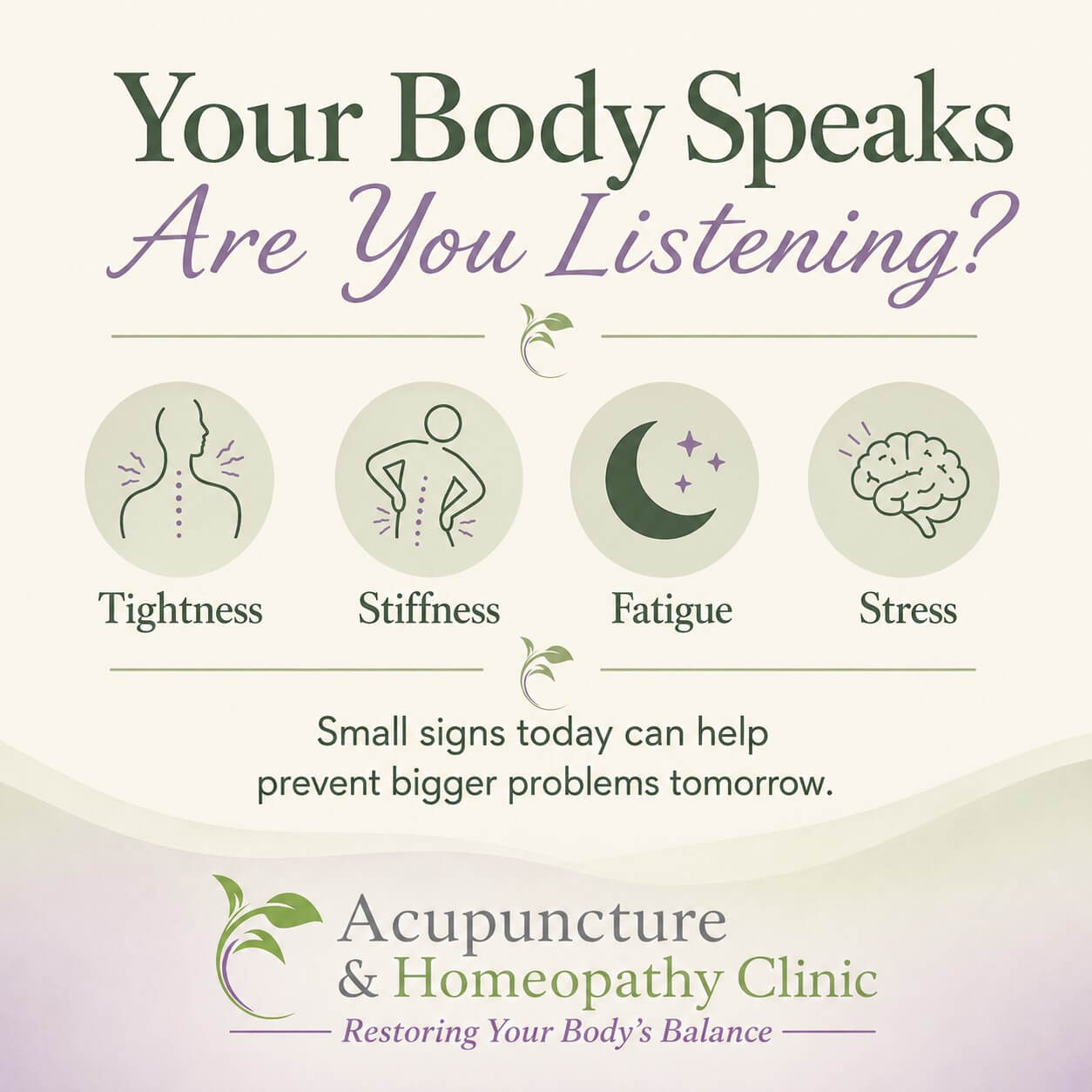
Five Ways to Listen to Your Body
Notice patterns: Write down when symptoms appear, what you were doing, how long they lasted, and what helped. Patterns are often easier to recognize on paper than from memory.
Pay attention to function: Ask whether you are moving differently, avoiding activities, sleeping poorly, or relying on the other side of your body. These changes can matter even when pain is mild.
Keep moving within your limits: Regular activity supports health and function, but pushing through sharp or worsening pain is not the same as healthy movement. Choose activities that feel appropriate and seek guidance when you are unsure.
Protect recovery time: Sleep, hydration, nourishment, and pauses during repetitive work are not luxuries. They are part of the environment your body needs to recover.
Ask for help sooner: Recurring or worsening symptoms deserve a professional assessment.
Questions I Hear Often
If my pain comes and goes, does that mean the problem is minor?
Not necessarily. Symptoms can change with activity, posture, stress, or compensation. A recurring pattern is worth discussing when it affects movement, sleep, or daily life.
Should I wait until the pain is severe before booking an appointment?
No. Repeated stiffness, reduced range of motion, or avoiding activities may justify an evaluation. The appropriate treatment depends on your symptoms and medical history.
Can stress really make physical symptoms worse?
Yes. Stress can increase muscle tension, change breathing, disturb sleep, and influence discomfort. This does not make symptoms imaginary. It shows why physical and emotional health should be considered together.
Will one treatment fix the problem?
Sometimes people feel a meaningful change quickly, but lasting improvement often takes time. The number and type of treatments depend on the condition, how long it has been present, the person’s health, and the goals of care.
How do I know which service is right for me?
The best choice begins with a consultation. We review the symptoms, history, movement, goals, and current care, then discuss which services may be appropriate.
A Final Thought
One thing I have learned throughout my career is that the body is incredibly patient. It adapts, it compensates, it finds ways to keep us moving, often long after something has begun asking for attention.
My hope is that this article encourages you to listen sooner. Not because every ache is serious, but because your comfort, movement, sleep, and confidence matter. Noticing a pattern today may help you make a wiser decision tomorrow.
Healing rarely begins with a dramatic moment. More often, it begins with awareness, a thoughtful question, and the decision to care for yourself before discomfort becomes the center of your life.
| Ready to Listen? If recurring stiffness, discomfort, or reduced movement has been getting your attention, schedule a consultation so we can discuss what you are experiencing and whether our services are appropriate for you. |
Acupuncture & Homeopathy Clinic
7241 Bryan Dairy Road, Largo, FL 33777
(727) 420-7600 | ANHClinic.com
Restoring Your Body’s Balance