
Measure progress. Assess. Treat. Reassess. Why seeing change matters as much as feeling it.
When someone comes into my clinic because they are hurting, one of the first questions I usually hear is very simple:
“Can you make the pain go away?”
Of course, pain matters. If your shoulder hurts every time you reach overhead, your lower back aches when you stand, or your neck has been tight for weeks, relief is probably the reason you made the appointment.
But pain is only one part of the picture.
Sometimes a patient finishes a treatment and says, “It still hurts a little,” while completely overlooking the fact that they can now raise their arm higher, turn their head farther, stand more comfortably, or move in a way they could not before treatment.
That change matters.
And I do not want my patients to have to guess whether they are improving.
That is why I am placing even more emphasis on three simple steps in my clinic:

Assess. Treat. Reassess.
It is a straightforward process to measure progress, but it can tell us a great deal.
Before treatment, I want to understand what is happening.
During treatment, I want to choose the therapy that makes sense for what I found.
Afterward, I want to look again.
Did your movement change?
Did the tension decrease?
Can you perform the motion more easily?
Did your pain level change?
Can you do something you could not do before?
Treatment should not simply be something that happens while you lie on a table. You should understand what we are working on and be able to recognize when your body begins to respond.
That is how we make progress visible.
Assessment Gives Us a Starting Point
Every person who walks into my clinic brings a different story.
Two people may both tell me they have shoulder pain, but that does not mean the same thing is happening in both bodies.
One person may have very limited range of motion.
Another may be able to move the shoulder normally, but certain muscles are extremely tight.
Someone else may have developed compensation patterns because they have been protecting an old injury.
Another person may feel the problem in the shoulder even though the tension involves the neck, upper back, chest, or opposing muscle groups.
This is why I do not want to begin with the assumption that a particular treatment is automatically the answer.
First, we need a baseline.
Depending on the problem, an assessment may include looking at things such as:
- range of motion
- where movement becomes restricted
- muscle tension
- posture or compensation patterns
- what movements increase discomfort
- pain level
- strength or functional ability
- what activities have become difficult
Sometimes the most useful assessment is surprisingly simple.
Can you raise your arm above your head?
Can you rotate your neck comfortably?
How far can you bend forward?
Can you stand from a chair without using your hands?
Can you reach behind your back?
Can you comfortably turn your torso?
These are real movements that affect everyday life.
When we establish where you are before treatment, we have something meaningful to compare afterward.
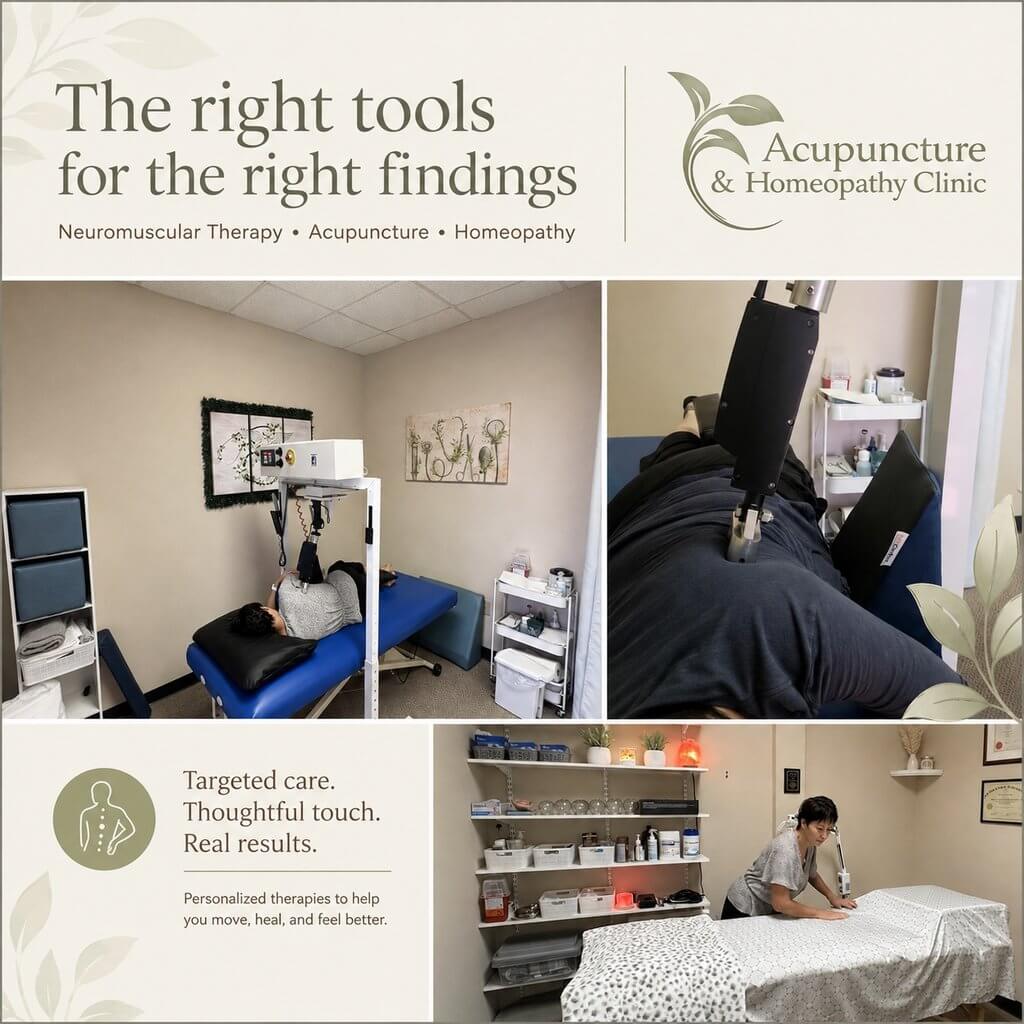
Treat What You Find. Assessment is only useful if it guides what happens next.
One of the reasons I have expanded the therapies available in my clinic is because I do not believe every problem should be approached with exactly the same tool.
There are times when acupuncture makes sense.
There are times when Neuromuscular Therapy may be particularly helpful.
Sometimes cupping, Gua Sha, homeopathy, homeopathic injections, red light therapy, or a combination of therapies may be appropriate within an individualized treatment plan.
The question should not be:
“Which therapy is best?”
The better question is:
“What am I finding in this patient, and which treatment tool makes sense for it?”
That distinction is important.
Neuromuscular Therapy and Muscular Tension
One of the tools I now use extensively is Neuromuscular Therapy with the Meilus Thebo Robot.
Many people initially think of this only as a therapy for improving movement.
It certainly can help with movement, but that is not the whole story.
Muscles rarely work independently.
Your body depends on groups of muscles coordinating with one another. When one muscle group becomes excessively tight, shortened, overworked, or protective, opposing muscles may begin fighting against that tension.
That constant pull can contribute to discomfort.
Think about a tug-of-war.
If one side keeps pulling harder, the other side has to react.
Your body can develop a similar pattern.
By addressing excessive muscular tension and the muscles pulling against one another, Neuromuscular Therapy may help decrease that strain. As tension changes, patients may experience less discomfort along with better mobility and function.
This is another reason assessment matters.
I want to identify where the restriction or tension actually exists, rather than simply treating the location where the patient feels pain.
The place that hurts is important.
But it is not always the whole problem.
Where Acupuncture Fits
Acupuncture approaches the body differently.
From a traditional acupuncture perspective, treatment involves identifying patterns of imbalance and helping restore healthy flow through the body’s channels.
The needles provide stimulation at carefully selected points.
In modern terms, acupuncture is also being studied for its effects on the nervous system, circulation, muscle activity, and the body’s response to pain.
But I do not look at acupuncture as simply “the pain treatment.”
That would be too narrow.
Sometimes the goal is stimulating an area that has become restricted.
Sometimes I want to work with circulation.
Sometimes I am addressing tension or the body’s broader response to stress.
Sometimes acupuncture is one part of a treatment that also includes muscular work.
This is where combining therapies can become particularly useful.
Neuromuscular Therapy may help address mechanical tension between muscles while acupuncture approaches the body through a different pathway.
They are not competing treatments.
They can complement each other.
Using More Than One Tool
Imagine someone comes in with chronic neck and shoulder discomfort.
During the assessment, I find that the shoulder is not moving through its normal range.
The upper trapezius may be extremely tight.
Muscles around the shoulder blade may be compensating.
Turning the head may also be restricted.
In that situation, simply putting acupuncture needles where the patient reports pain may not address everything I am seeing.
Neuromuscular Therapy might help release some of the muscular tension.
Acupuncture may be used to stimulate particular points and address the broader pattern I find.
Cupping may be useful when I want another way to work with tissue tension and circulation.
The treatment becomes a strategy rather than a routine.
The same idea applies throughout the clinic.
My goal is not to use every therapy on every patient.
My goal is to have enough tools available that I can choose what makes sense.
That is a major difference.
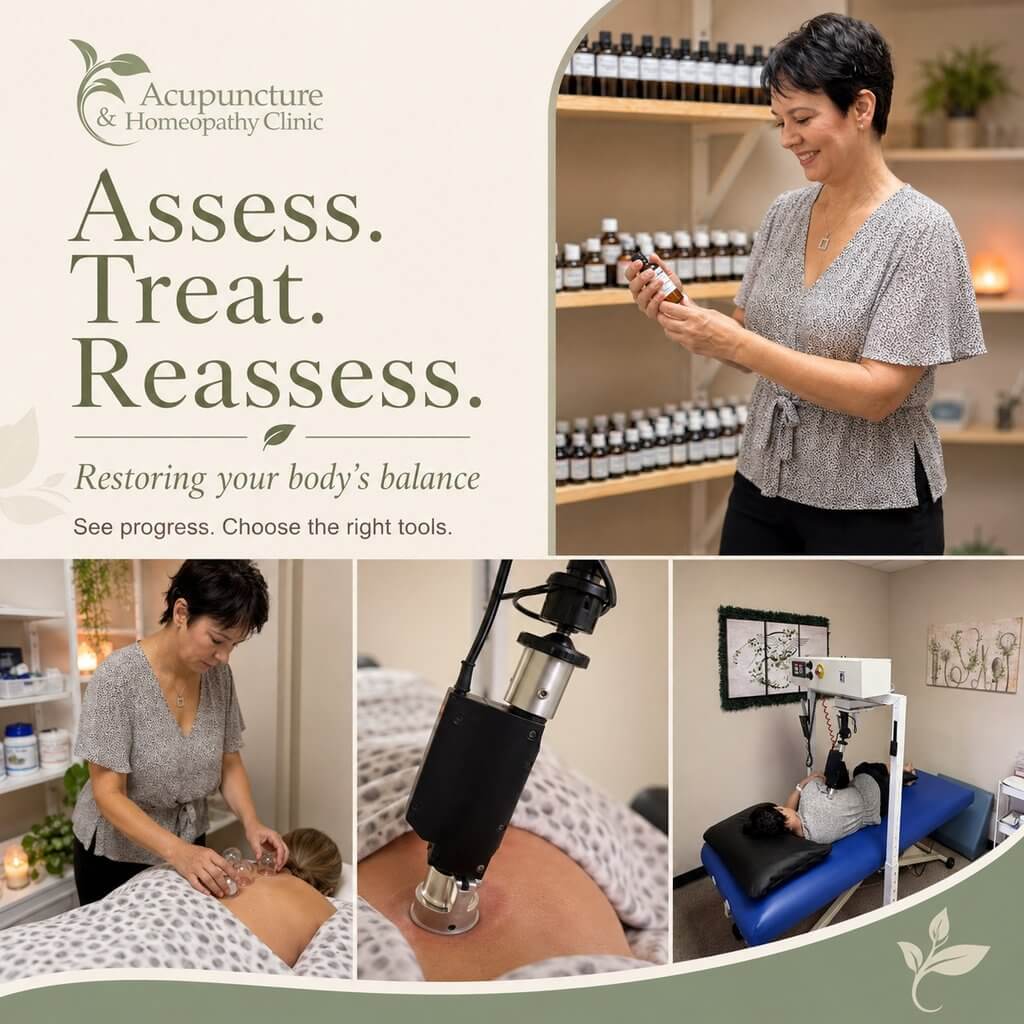
Then We Reassess
This may be the most overlooked part of treatment.
After working on the problem, we should check again.
Not simply:
“How do you feel?”
That is useful information, but I want more.
If you could only raise your arm to a certain point before treatment, try it again.
If you could not comfortably rotate your neck to the left, let’s see what happens now.
If bending forward was limited, repeat the movement.
If standing from the chair was difficult, try it again.
Now we can compare.
That does not mean every treatment is going to produce a dramatic transformation in one visit.
Bodies do not work that way.
Some problems have developed over months or years.
Old injuries, repetitive movement, posture, stress, muscle guarding, scar tissue, inflammation, lifestyle and many other factors can influence recovery.
But even when the change is small, measuring it gives us information.
A few additional degrees of motion matter.
Less pulling matters.
Moving with less hesitation matters.
Being able to stand five minutes longer matters.
Sleeping through the night matters.
Needing your hands less when you get out of a chair matters.
Progress does not always arrive as a dramatic moment.
Often, it arrives in small changes.
Pain Is Not the Only Score
Patients naturally focus on pain because pain gets our attention.
If you came in at an eight out of ten and leave at a three, that change is easy to recognize.
But what if your pain changes from a six to a five?
It might be tempting to think the treatment did very little.
Then we check your shoulder again.
Before treatment, your arm stopped at shoulder height.
Now it reaches almost completely overhead.
That is meaningful progress even if some discomfort remains.
Or perhaps your back still feels sore, but you can bend farther and stand up more easily.
Again, something changed.
When we only ask about pain, we can miss improvements in function.
And function is often where patients begin getting their lives back. This is why we measure progress.
Reassessment Helps Me Too
Reassessment is not only for the patient.
It tells me whether the treatment strategy made sense.
If I work on an area and we see improvement, that gives me valuable information.
If very little changes, that tells me something too.
Perhaps we need another approach.
Perhaps another muscle group is contributing.
Perhaps acupuncture should be incorporated.
Perhaps we need to spend more time on a particular area.
Perhaps what appeared to be the problem was actually compensation for something happening somewhere else.
Treatment should evolve based on what the body shows us.
That is one reason I do not like the idea of simply repeating the exact same treatment indefinitely.
We should be paying attention.
Assess. Treat. Reassess. Adjust when necessary.
Seeing Progress Builds Confidence
There is another reason I want patients to see these changes.
Treatment requires participation.
For many conditions, one appointment may begin the process, but lasting improvement can require repeated care and changes over time.
When patients cannot see progress, it is understandable that they begin wondering:
“Is this actually doing anything?”
I do not want someone continuing treatment simply because I tell them they should.
I would much rather be able to show them:
“Look at where your arm stopped when you walked in.”
“Now look where it goes.”
“Remember how difficult that movement was?”
“Try it again.”
That makes the conversation completely different.
Instead of asking someone to simply trust the process, we can look at what their own body is showing us.
That is valuable for the patient, and it keeps me accountable as the practitioner. This is why we measure progress.
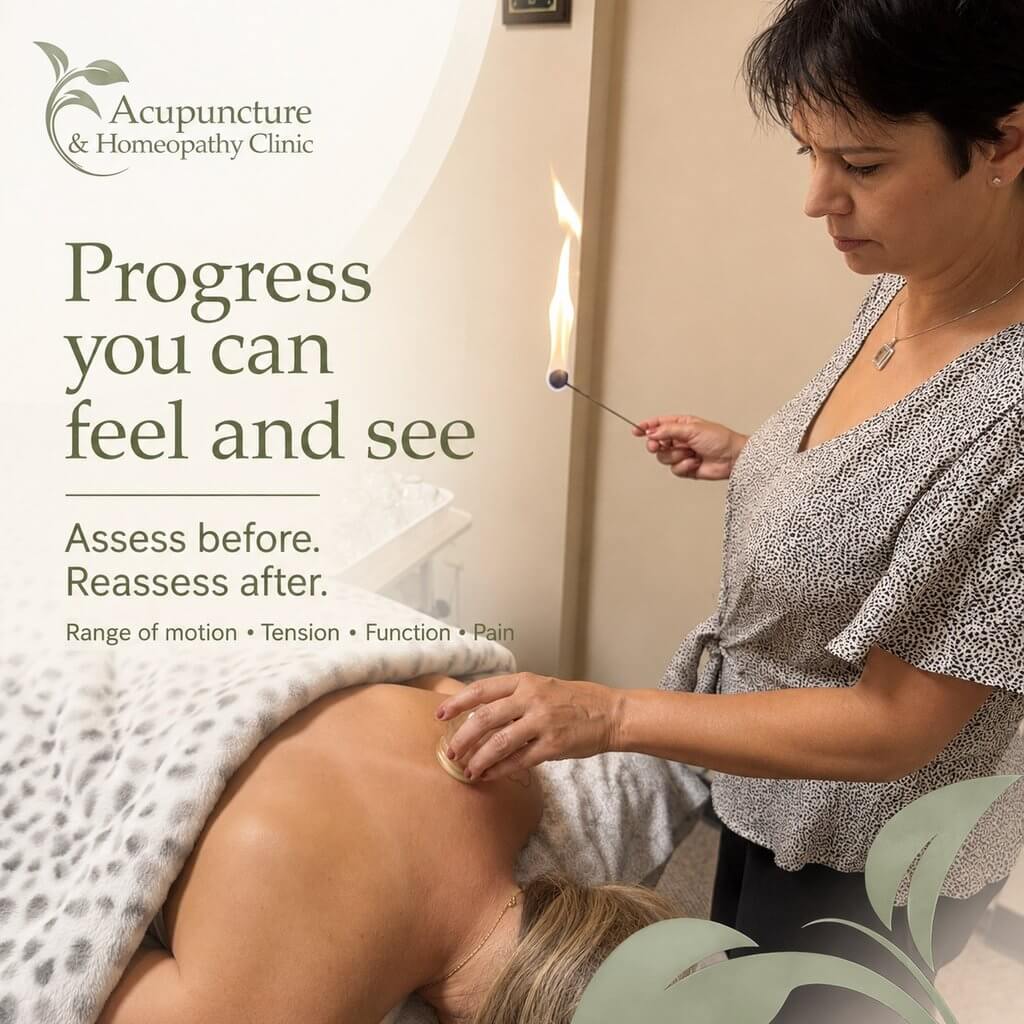
Restoring Your Body’s Balance
For years, the philosophy behind my clinic has been:
Restoring your body’s balance.
That has not changed.
What is changing is how intentionally I want to demonstrate the process that gets us there.
Assess. Treat. Reassess.
Assess what your body is doing today.
Treat according to what we find.
Reassess to see how your body responds.
Then use that information to decide what comes next.
The body is constantly giving us information.
Pain is information.
Restricted movement is information.
Tension is information.
Fatigue is information.
Improved movement is information too.
So is decreased tension.
So is walking farther.
So is reaching higher.
So is being able to do something today that was difficult yesterday.
Those changes deserve to be noticed.

Your Treatment Should Have a Purpose
I want every patient who walks through my clinic doors to understand that treatment is not about randomly choosing therapies from a menu.
There should be a reason behind what we are doing.
Sometimes that reason leads me toward Neuromuscular Therapy.
Sometimes acupuncture.
Sometimes homeopathy.
Sometimes cupping.
Sometimes another therapy or a combination.
And sometimes the plan changes as the body changes.
That is exactly why reassessment matters.
The goal is not simply to finish a treatment session.
The goal is to learn something from it.
What changed?
What did not?
What is working better?
What needs more attention?
That information moves us forward.
Because ultimately, I do not only want you to tell me that you think you are improving.
Whenever possible, I want us both to be able to see it.
Assess. Treat. Reassess. Measure Progress.
Restoring your body’s balance.
If pain, tension or restricted movement is interfering with what you want to do, schedule an appointment with Acupuncture & Homeopathy Clinic in Largo, Florida. We can assess where you are now, discuss which treatment options may fit your needs, and begin measuring the changes along the way.